
Cognitive Prosthetics
Featuring color, clocks, mirrors, and a small German word for joy-hate

I can’t drive without Google Maps. My mechanics are fine—I’ve never hit anyone—but I’ll get lost on a route I’ve taken fifty times. Left to my own sense of direction, I become a hazard to myself and others.
In a pre-GPS timeline, I would have died lost in the woods before reproducing.
Also, I’m not particularly motivated to do nice things for myself. I’ll skip meals, ignore discomfort, delay everything. But if someone else is involved, I become alarmingly competent.
Apparently, my executive function is other people.
In both cases, I need to borrow something—someone else’s brain, a screen, a structure—to complete basic tasks.
Once while reading Homer I came across the phrase, “the wine-dark sea.” I assumed it was poetic.
Turns out ancient Greek didn’t have a word for blue.
In Japanese, ao used to mean both green and blue.
In Russian, light blue and dark blue are separate words—and are perceived as categorically distinct.
In Hebrew, the sky is “clear,” the sea “deep.” Not “blue.”
We tend to treat perception as universal. But color is a concept, not something in the environment.
If no one names blue, you don’t see blue. You see whatever else makes sense at the time.
When the whole sky is blue, it stops being a feature and becomes the background. Maybe that’s why some cultures never bothered to name it.
What’s true for color is true for thought.
The way we think seems like the default. It isn’t.
It’s contingent. Shaped by tools—linguistic, technological, social.
But much of what seems like “thinking” is actually scaffolded processing—offloaded onto mirrors, maps, clocks, categories, and other people.
Some of these tools are obvious. Many are invisible.
Let’s look at a few examples of mental prosthetics so deeply embedded they feel natural:
Perceptual Prosthetics
Ancient Greek had no word for “blue.” The ocean became wine-dark. Japanese ao originally included green.
Russian splits light and dark blue categorically.
Hebrew describes the sky as “clear,” not colored.
→ Color isn’t seen. It’s named. And naming changes what is seen.
The Guugu Yimithirr language (Aboriginal Australia) uses cardinal directions instead of left/right.
“There’s a bug on your southwest leg.”
Western minds orient egocentrically: left/right, front/back.
But “up/down” relies on gravity, “front/back” on locomotion. These aren’t universal—they’re just what we happened to build around.
Imagine life before mirrors. No accurate self-image. Your face belonged to others.
Mirrors enabled self-objectification—seeing yourself as seen.
From this came grooming, posturing, shame, performance.
Social media closes the loop: we now perform the self back to ourselves through screens.
Polynesian navigators orient using stars, birds, and wave patterns.
London taxi drivers develop enlarged hippocampi by memorizing every street (The Knowledge).
Semantic Prosthetics
The Pirahã (Amazon) have no words for exact numbers beyond “few” and “many.”
No counting → no arithmetic → no abstraction.
Many animist languages don’t divide self, body, and mind.
Chinese xin = heart-mind.
Ancient Hebrew links “person” and “body” as a single unit.
Concepts we treat as obvious—privacy, consent, luck—are recent.
Try explaining “consent” in the Iliad.
Schadenfreude: the beautiful German concept for pleasure at another’s misfortune. It existed before the word—but couldn’t be thought clearly until it was named.
Most of your inner life is only possible because someone gave it a name.
Memory Prosthetics
In oral cultures, the past is mutable—shaped by context and need.
Stories are performed, not stored.
Writing and printing froze time and made it linear.
Before mechanical clocks: polyphasic sleep, seasonal work, event-based time.
Clocks broke time into units. Made it ownable, salable, enforceable.
Burmese and Malay: no future tense. Time unfolds—it isn’t predicted.
Early texts (and minds) were linear: you had to remember the whole scroll.
Indexes, tables of contents, and page numbers made knowledge nonlinear.
Roman numerals had no zero. It came from India.
No zero = no algebra
The Missing Instrument
If Mozart had been born before the piano, what would he have become?
What we call talent or intelligence is often a mind plus a tool.
There are kinds of genius that only emerge when the right environment activates them.
What is the piano you haven’t yet found?
Your Wine-Dark Sea
What are you experiencing that you can’t yet name?
What problem feels blurry not because it’s hard—but because it lacks a concept?
What’s the affordance you haven’t yet installed?
Not all tools are objects. Some are people.
We think of self-reliance as strength. But much of cognition is distributed—shared across dialogues and relationships.
When I drive, I want a person riding shotgun with Google Maps open.
Your mind isn’t missing discipline. It might just be missing another mind—
“Man is the best computer we can put aboard a spacecraft, and the only one that can be mass produced with unskilled labor.”
—Wernher von Braun
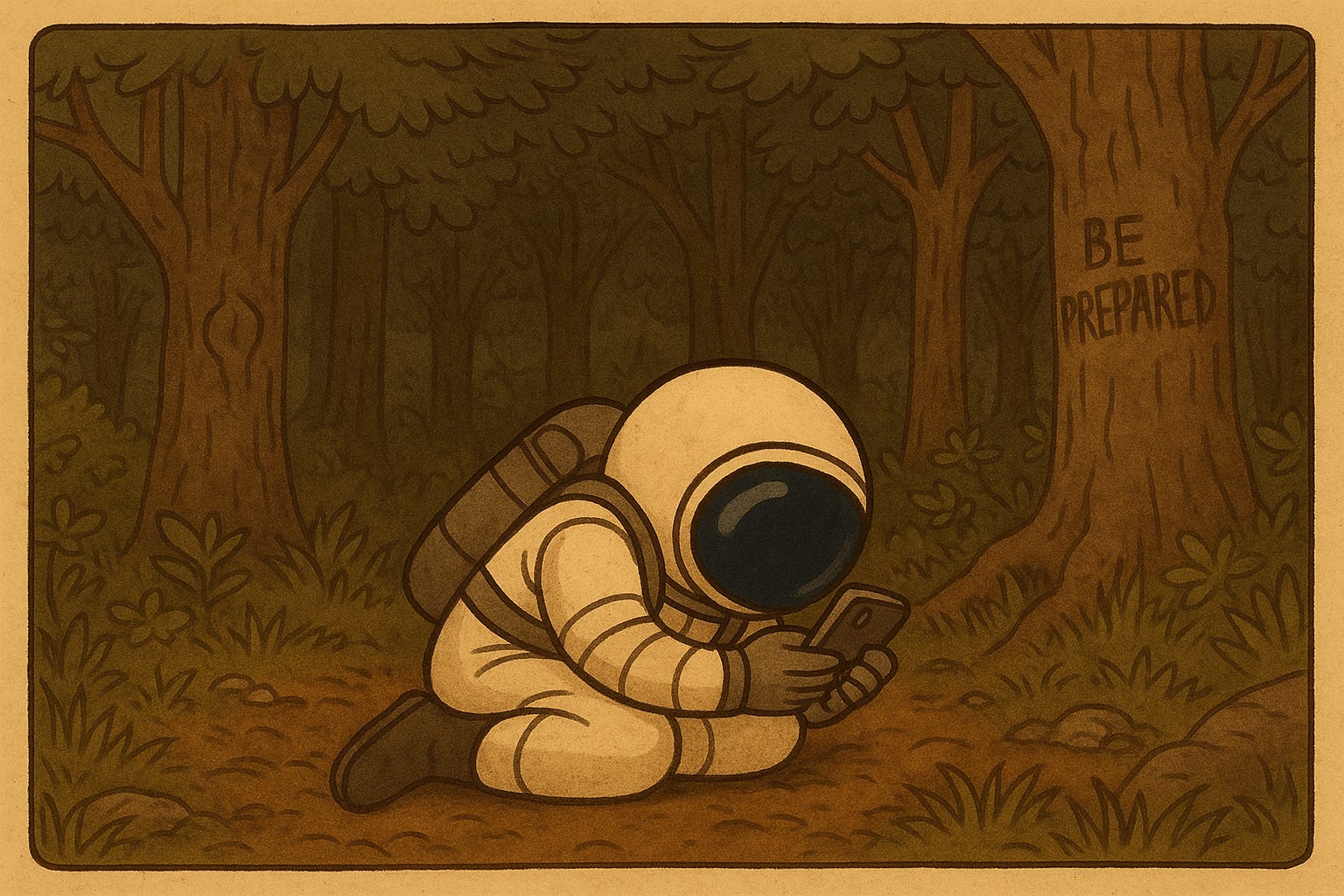
A lost, distraught millennial slumped in the woods. He is clearly the least capable organism present.